Research
Cool Robotics Labs You Should Know: Part 2
Discover the research labs driving breakthroughs in legged locomotion, soft robotics, embodied learning, and household AI.
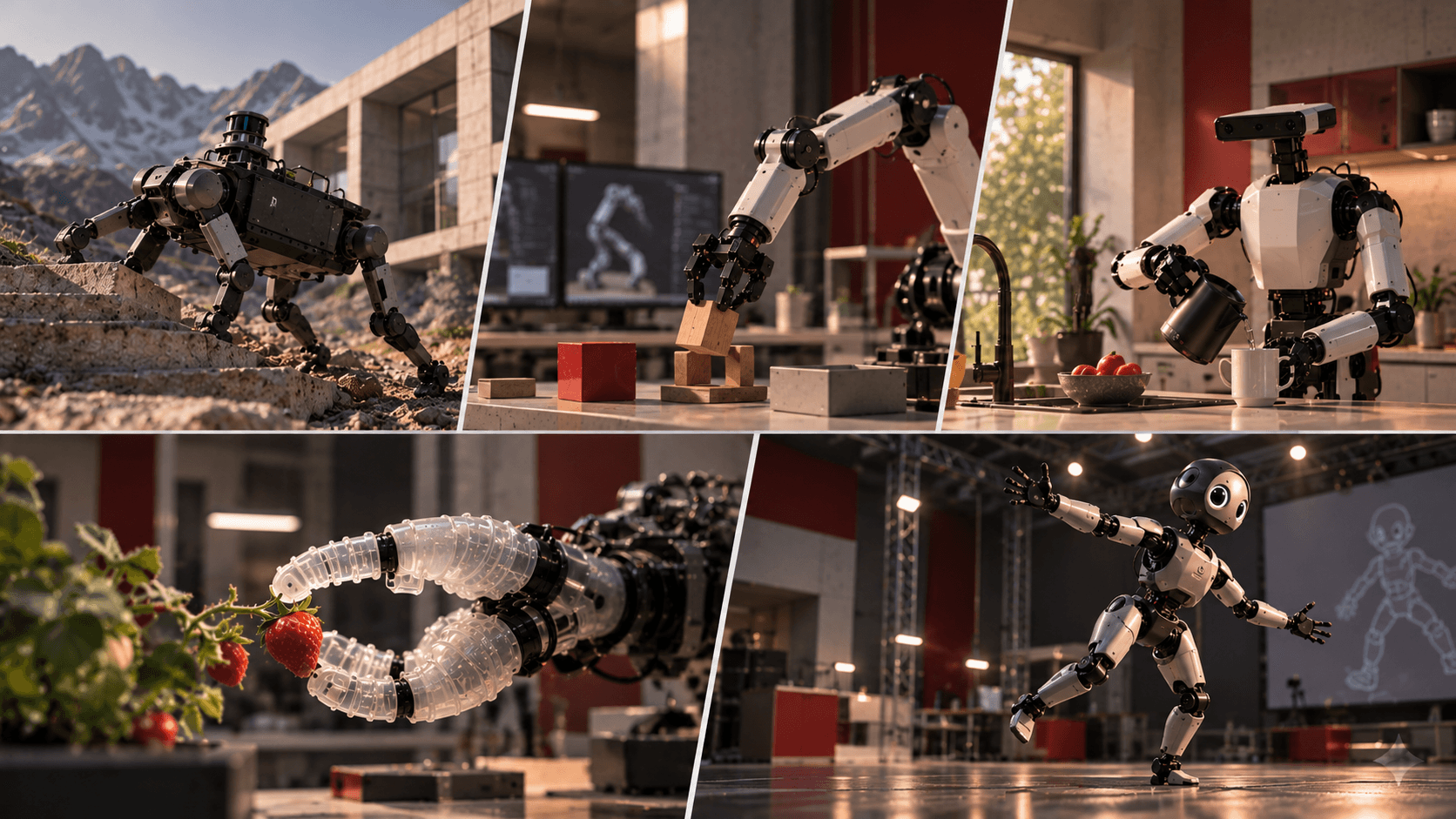
While proprietary corporate research receives substantial public coverage, many academic and institutional research groups publish their foundational breakthroughs openly. The second installment of our overview highlights five labs advancing physical intelligence across legged locomotion, robotic manipulation, household assistant systems, soft robotics, and expressive kinematics.
1. ETH Zurich Robotic Systems Lab (RSL)
The Robotic Systems Lab (RSL) at ETH Zurich specializes in dynamic legged locomotion and robotic systems engineered for unconstrained, high-risk environments. RSL’s work focuses on combining model-based control with deep reinforcement learning, enabling quadrupedal and legged platforms to navigate unpredictable terrain without pre-mapped pathways.
RSL is best known for developing ANYmal, an autonomous quadruped built for extreme environments, industrial plant inspections, and search-and-rescue operations. Research from the lab frequently focuses on blind locomotion, teaching robots to climb stairs, traverse shifting rubble, and recover stability purely through haptic feedback and joint torque sensing before visual cues are processed.
2. Berkeley AI Research (BAIR)
Located at UC Berkeley, Berkeley AI Research (BAIR) operates as a primary center for learning-based robot manipulation and embodied AI. Rather than programming deterministic trajectory paths, researchers at BAIR train policies using large-scale data collection, reward optimization, and offline reinforcement learning.
BAIR’s manipulation demonstrations highlight zero-shot generalization across novel, unseen objects. Their published work covers a wide spectrum of physical interaction challenges, including cloth folding, contact-rich assembly, deformable object manipulation, and robot learning from demonstration. As outlined in our post on why robots need to understand space, not just objects, bridging perception and control remains a core focus of BAIR’s research agenda.
3. Toyota Research Institute (TRI)
While many corporate entities target industrial automation, the Toyota Research Institute (TRI) focuses heavily on human-centric robotics, assistive domestic systems, and functional safety in living spaces. TRI's research operates at the intersection of soft manipulation, diffusion-based policy learning, and human-robot collaboration.
TRI has published significant work utilizing diffusion policies to teach domestic robots multi-step household tasks such as wiping kitchen surfaces, clearing tables, and operating appliances. By training on human teleoperation data, TRI's systems learn fluid, continuous motions capable of accommodating unpredictable home layouts and fragile items.
4. Max Planck Institute for Intelligent Systems
The Max Planck Institute for Intelligent Systems (MPI-IS) takes a fundamental, bio-inspired approach to robotics. Located in Stuttgart and Tübingen, Germany, MPI-IS investigates dynamic perception, physical intelligence, and soft robotics—challenging the assumption that robots must be constructed from rigid metals and high-gear-ratio motors.
Researchers at MPI-IS design flexible grippers, soft actuators, and bio-inspired locomotive mechanisms that mimic living organisms. By exploiting physical compliance, these soft systems handle delicate, irregularly shaped objects and adjust to physical impacts passively, reducing the computational load required for explicit contact modeling.
5. Disney Research
Robotics applications extend beyond manufacturing facilities and warehouse logistics. Disney Research leads advancements in character robotics, developing dynamic bipedal platforms engineered specifically for expressive, natural, and entertaining human interaction.
Disney's roboticists combine reinforcement learning with expressive kinematic pipelines. Rather than prioritizing energy efficiency or high-speed payload transfer, their systems optimize for stylistic locomotion, character posture, and real-time balance control. Platforms like their untethered bipedal droids demonstrate how dynamic balance algorithms can maintain stability while preserving deliberate artistic motion profiles. Similar advancements in physical hardware form factors are detailed in our piece on 5 humanoid robots pushing robotics in new directions.
The Intersection of Hardware and Intelligence
Pushing physical AI forward requires continuous interaction between hardware engineering and learning algorithms. Whether through bio-inspired soft actuators, dynamic quadruped balance, or diffusion-based manipulation policies, these open research groups provide the foundational datasets, architectures, and hardware blueprints shaping general-purpose robotics.
FAQ
What is the primary focus of ETH Zurich's Robotic Systems Lab?
ETH Zurich's RSL focuses on dynamic legged locomotion, quadrupedal navigation across rough terrain, and autonomous systems designed for industrial inspection and disaster response environments.
How does Berkeley AI Research approach object manipulation?
BAIR utilizes machine learning techniques—such as reinforcement learning, imitation learning, and vision-based control—to teach robots how to grasp, manipulate, and adapt to novel objects without explicit hand-coded rules.
Why does Disney Research build bipedal robots?
Disney Research develops bipedal robots to create expressive, character-driven machines capable of walking, balancing, and interacting safely and naturally with human environments in real time.
How does soft robotics differ from traditional robotics?
Soft robotics uses flexible, compliant materials and fluidic or bio-inspired actuators instead of rigid links and metal joints. This compliance allows robots to deform safely around obstacles and handle fragile objects passively.