# What Even Is a Robot? (It's Messier Than You Think)
> A Roomba, an arm, a drone, a Tesla. What makes a machine a robot? The definition is messy, but almost every robot runs one loop: sense, think, act.
**Author:** Drift Team
**Published:** 2026-06-12
**Tag:** Product
**Reading time:** 4 min
**Canonical URL:** https://godrift.ai/blogs/what-is-a-robot
------
A Roomba, a robotic arm, a self-driving car, a drone. Where's the line between a machine and a robot? Blurrier than you'd think, but they all share one thing.
## When does a machine become a robot?
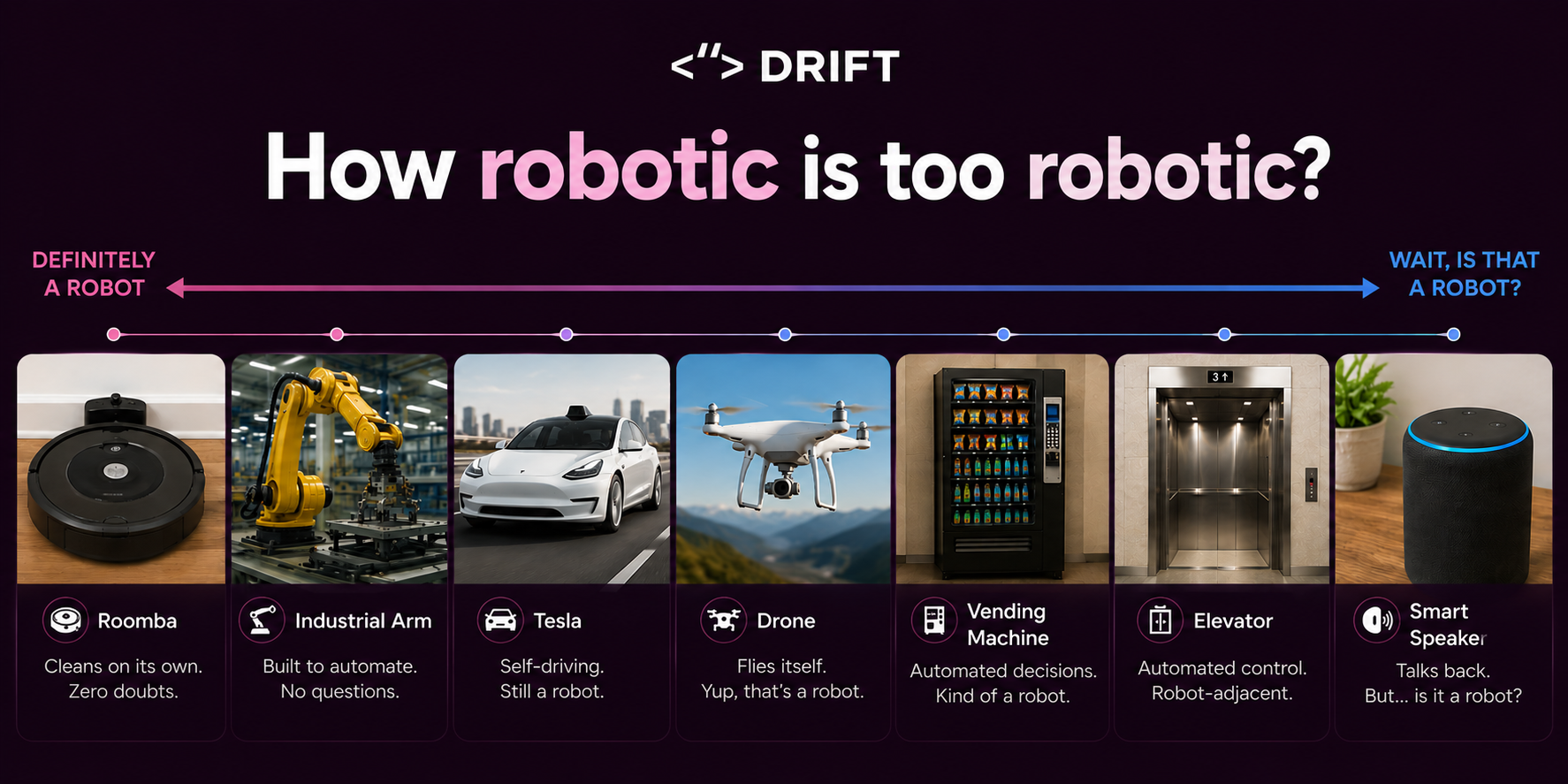
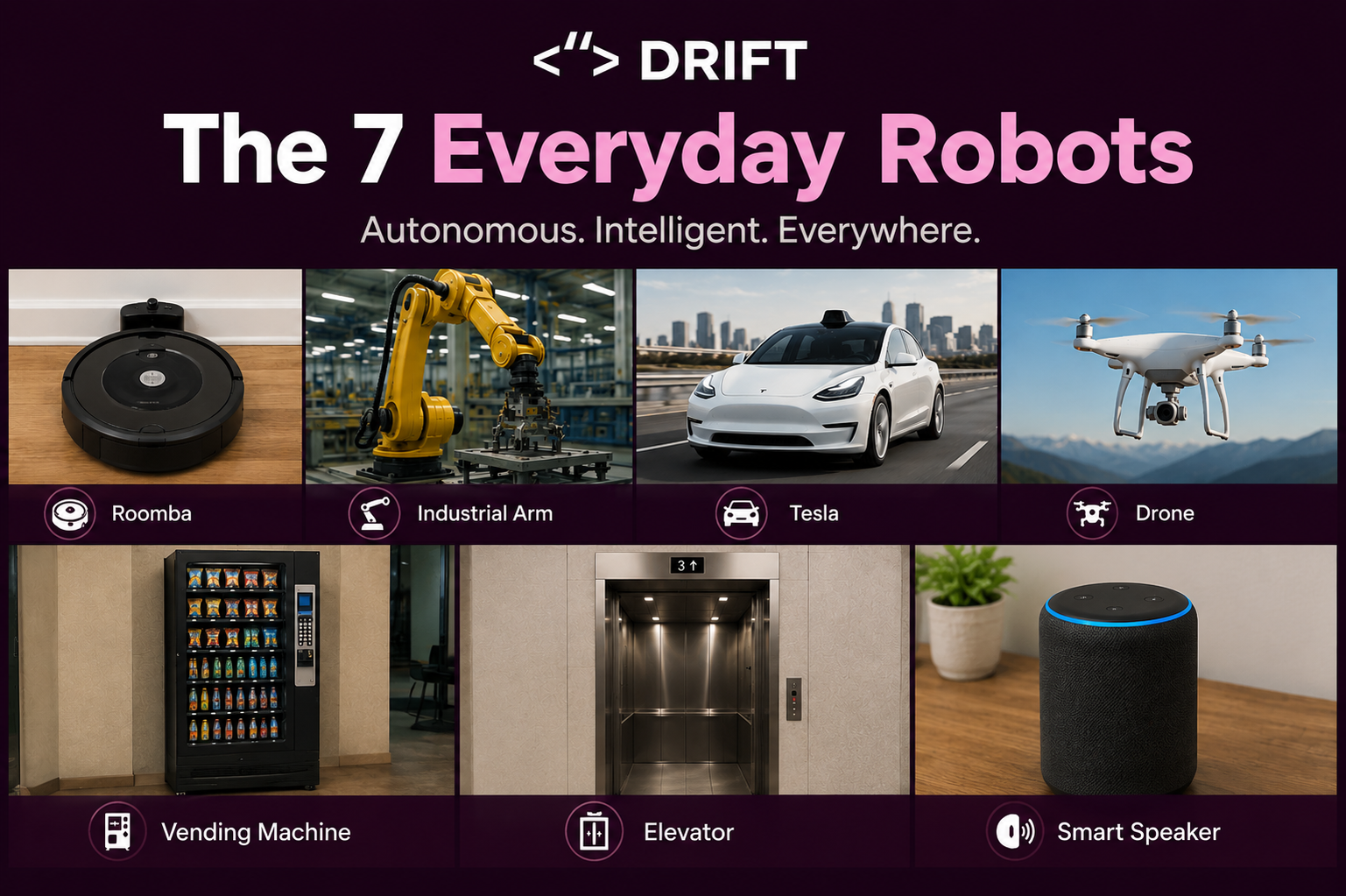
Picture a few things in a row. A robot vacuum. An industrial arm on a factory line. A self-driving car. A drone. Then a vending machine. An elevator. A smart speaker.
The first few feel obviously robotic. Somewhere around the vending machine and the elevator, your confidence starts to wobble. Both sense input and act on it, so what disqualifies them?
At what point does something stop being a machine and start being a robot?
The further right you go, the less sure anyone is. That fuzzy middle is the whole problem.
## Why there's no single definition of a robot
If you go looking for one crisp definition, you won't find it. Ask a room of engineers and you'll get a room of arguments.
The disagreements tend to circle the same questions. Does a robot have to be autonomous, or does a remote-controlled machine count? Does it need to be reprogrammable? Must it physically move something in the world, or can a piece of software be a robot? Every definition that sounds tidy ends up either letting in a dishwasher or shutting out something most people would call a robot.
Underneath all the arguing, there's a pattern almost everyone's examples share.
## The sense, think, act loop every robot shares
Popular explainers call it sense-think-act. In robotics textbooks it's the sense-plan-act paradigm. Same idea.
Strip away the shape and the branding, and most robots run the same three-step cycle, over and over.
- **Sense:** First, the robot takes in the world. Cameras, LiDAR and other sensors, microphones, GPS. This is perception: turning physical reality into data the machine can work with. Without sensing, a robot is basically improvising reality.
- **Think:** Next, it processes what it took in. Is there an obstacle? Where should I move? What object am I looking at? Sometimes this is simple pre-programmed logic, like stopping before a wall. Sometimes it's AI weighing options and predicting outcomes. Either way, this is where a decision gets made.
- **Act:** Finally, the robot does something. Wheels turn. An arm moves. A drone adjusts its flight. The moment it acts, it changes the world around it, which gives the sensors something new to perceive, and the loop starts over.
Sense feeds think, think feeds act, and acting changes what gets sensed next.
## Sense, think, act in action: how a robot vacuum works
The clearest everyday example is the robot vacuum bumping around your floor. It **senses** walls and furniture using its onboard sensors. It **thinks** about where the obstacles are and what that means for its path. Then it **acts** by changing direction and driving on.
It runs that cycle hundreds of times every minute, which is why a cheap disc on wheels can cross a cluttered room without help.
## So, what is a robot? Different shapes, same loop
How human a robot looks turns out to be a poor guide. The better test is the loop. A robot is a machine that can sense the world, process that information, and act on it, then do it again. By that test, the industrial arm, the self-driving car, and the floor vacuum are all clearly robots, even though they share almost nothing in appearance.
Different shapes. Same loop.
Curious how this loop plays out in real simulations? See how Drift builds a [mobile robot simulation in ROS 2 from a single prompt](https://www.godrift.ai/blogs/mobile-robot-sim-ros2).
## FAQ
1. **What is a robot?** There's no single universally accepted definition, but a practical one is: a machine that can sense its environment, process that information to make a decision, and act on the physical world, repeating that cycle. The form it takes can vary widely.
2. **What is the sense, think, act loop?** It's the basic cycle most robots follow. The robot senses the world through sensors, processes that data to decide what to do, then acts through motors or actuators. Acting changes the environment, which the robot senses again, closing the loop.
3. **What's the difference between sense-think-act and sense-plan-act?** They describe the same core idea. "Sense, think, act" is the common plain-language version, while "sense-plan-act" is the term used in robotics literature for the classic deliberative paradigm. Reactive and hybrid paradigms are variations on how the thinking step is handled.
4. **Do all robots use AI?** No. The "think" step can be simple pre-programmed logic, like stopping before a wall, or it can be AI that evaluates options and predicts outcomes. Many useful robots use little or no machine learning.
5. **Is a self-driving car a robot?** By the sense-think-act test, yes. It senses with cameras, LiDAR, and radar, processes that data to plan a path, and acts by steering, accelerating, and braking, continuously and on its own.