Product
Automating Pick and Place With the Franka Panda in MuJoCo
Building the scene was step one. See how Drift automates a pick-and-place sequence for the Franka Panda arm in MuJoCo, grasp, lift, and place, from one prompt.
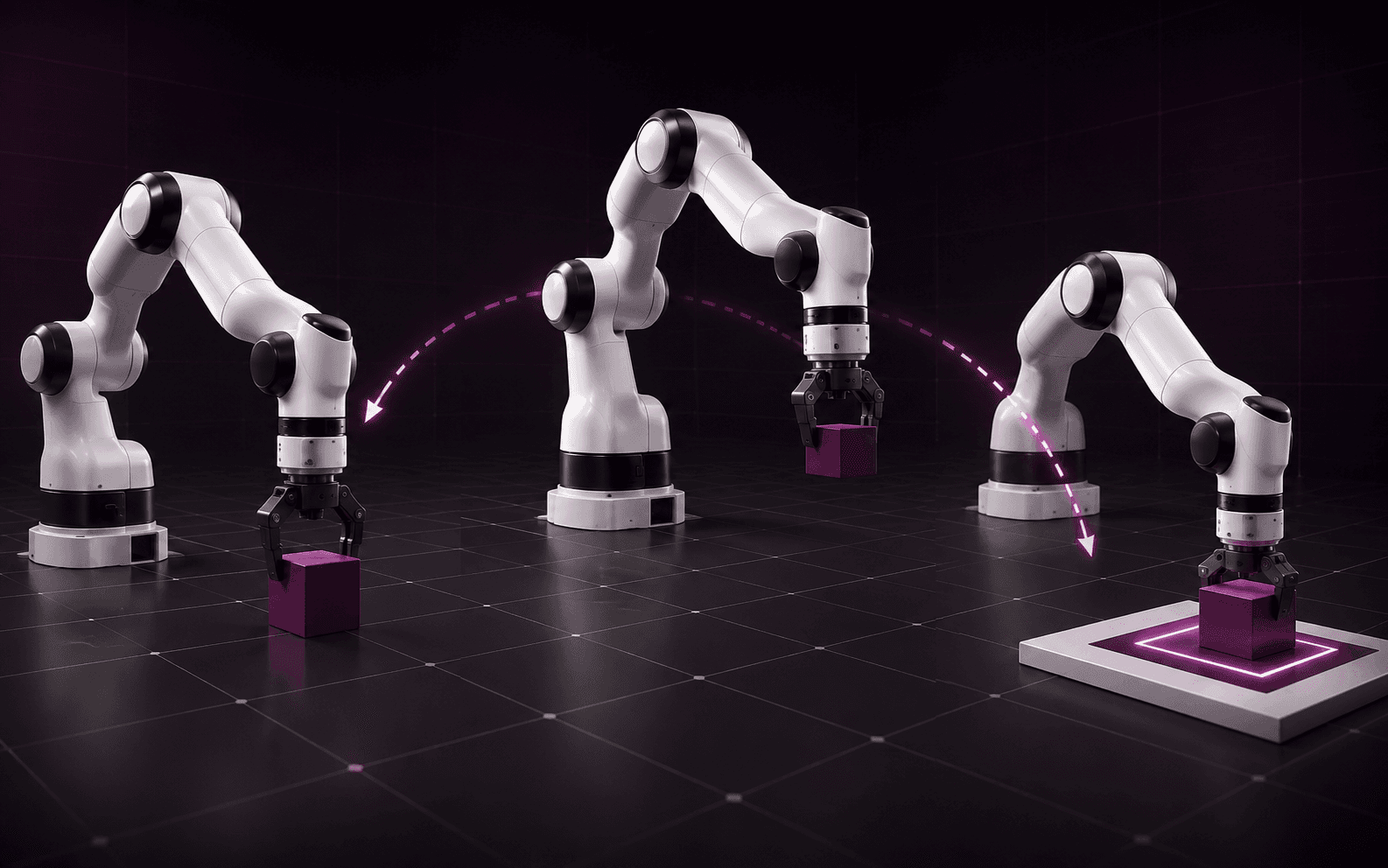
We already built the scene: a Franka Panda arm, a cube and a target. Moving the arm by hand is one thing. Can it run the whole sequence on its own?
This walkthrough automates pick and place with the Franka Panda in MuJoCo, asking Drift to generate the full sequence so the arm grasps, lifts, and places the object without any manual control.
From a manual arm to an automated pick-and-place task
Picking things up and putting them down sounds trivial, but it's one of the foundational skills in robotics. A full pick-and-place sequence has to move the arm to the object, align the gripper, close it at the right moment, lift without dropping, travel to the target, and release, each step depending on the one before.
Writing that motion logic by hand is fiddly. Getting the timing and positions right is exactly the kind of work that eats an afternoon, which is why automating the generation of it is useful.
The prompt: automate the sequence with Drift
Starting from the existing scene, we give Drift a simple prompt: create an automatic pick-and-place sequence for the existing Franka Panda arm in MuJoCo, and save it as a named script.
That's the whole instruction. There's no need to specify every waypoint or gripper command, since the goal is described at the task level and Drift works out the sequence to achieve it.
How Drift generates and integrates the motion sequence?
From that prompt, Drift updates the controller, generates the required motion sequence, and integrates it into the existing simulation. The pick-and-place logic is written into a script and wired into the scene we already had, rather than replacing it.
What would normally be careful, hand-tuned motion code is produced in one step and left ready to run. If you're starting earlier, here's how to build the pick-and-place scene and how to install MuJoCo first.
Watching the Franka Panda pick and place on its own
Time for the real test. We launch the simulation and let it run.
The Panda arm moves toward the cube, grasps it, lifts it clear of the table, carries it across, and places it on the target location, all automatically. No manual joint adjustments, no step-by-step control. The task the scene was built for now runs end to end on its own.
Why pick and place is a foundational robotics skill?
This is a simple pick-and-place task, but it's one of the most fundamental skills in robotics. Almost every practical manipulation job is some version of it: move to an object, grasp it, and put it somewhere useful.
Once a robot can reliably pick, move, and place objects, that skill scales toward real applications, from warehouse automation and order fulfillment to industrial assembly. With Drift generating the sequence, you get a working automated task quickly and can spend your time refining the grasp, testing new objects, or building toward more complex behaviors. The full run is in the video above.
FAQ
- How do you automate a pick-and-place task in simulation? You need a motion sequence that moves the arm to the object, grasps it, lifts and transports it, and releases it at the target. In this walkthrough, Drift generates that full sequence for a Franka Panda arm and integrates it into an existing MuJoCo scene from a single prompt.
- What is a pick-and-place task in robotics? Pick and place is a manipulation task where a robot grasps an object at one location and places it at another. It's a foundational skill behind many real applications, including assembly, packaging, sorting, and warehouse automation.
- What is the Franka Panda used for? The Franka Emika Panda is a seven-joint collaborative robot arm widely used in research and education. Its dexterity and readily available simulation models make it a common choice for manipulation and pick-and-place experiments.
- Why is pick and place considered a fundamental robotics skill? Because most practical manipulation reduces to it: reach an object, grasp it, and move it somewhere. Once a robot can do this reliably, the same capability underpins tasks from industrial assembly to logistics.
- What does Drift generate for an automated pick-and-place task? Drift updates the controller, generates the motion sequence for the pick-and-place task, and integrates it into the existing MuJoCo simulation as a script, all from a natural-language prompt, so the arm runs the full task automatically.