Research
Why NVIDIA Cares So Much About Robots?
NVIDIA is famous for graphics cards, so why pour billions into robotics? Because it builds the AI, simulation, and computing platform that powers the robots.
Say NVIDIA and most people think graphics cards. So why is one of the world's biggest AI companies pouring billions into robotics?
The short answer to why NVIDIA cares about robotics is that it sees the same opportunity it captured in AI: not the flashy end product, but the platform everyone else builds on.
What NVIDIA actually builds for robotics?
While companies like Figure and Tesla build the physical robots, NVIDIA is building the AI, simulation tools, and computing platform that power many of them. It's a supplier-to-everyone strategy rather than a compete-with-everyone one.
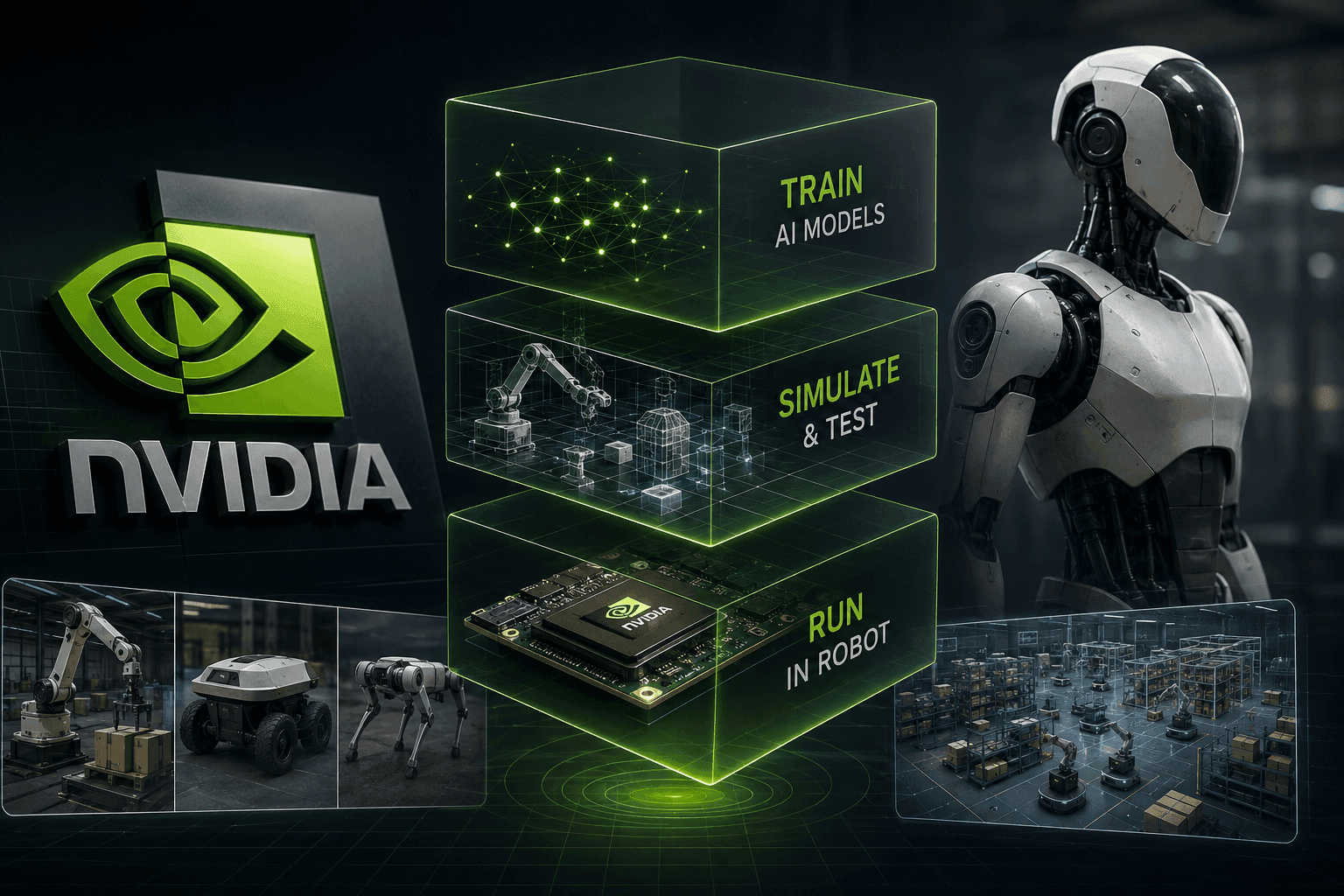
NVIDIA frames this as "three computers": one to train a robot's AI, one to simulate and test it, and one to run it inside the robot itself. Own all three layers, and you power robots regardless of which company ends up building the winning hardware.
Isaac Sim and training robots in simulation
The middle layer is where a lot of the action is. Tools like NVIDIA's Isaac Sim let developers train and test robots in simulation before they ever touch real hardware, with a companion framework, Isaac Lab, focused on training robot policies at scale.
This matters because training robots in the real world is slow, expensive, and risky. A physical robot can only practice one attempt at a time, and mistakes can break it. In simulation, thousands of virtual robots can practice in parallel, safely, at a speed no physical setup can match. That sim-to-real approach is central to modern robot learning.
GR00T and foundation models for robots
The AI layer is GR00T, NVIDIA's open foundation model for humanoid robots. Rather than programming one task at a time, the goal is a general model that helps robots perform a wide range of real-world activities, and that developers can fine-tune for their own machines.
It's the same foundation-model idea that reshaped language and images, now aimed at physical robots, and it's one of several AI models changing robotics right now. Paired with NVIDIA's Jetson Thor chips for on-robot computing, it completes the loop from training to deployment.
Why NVIDIA's platform-first bet could pay off?
Put the pieces together and the strategy is clear. Simulation makes robot learning faster and safer. Foundation models make robots smarter and more general. And NVIDIA's chips run underneath both. Together, these tools help robots learn faster, more safely, and at a much larger scale than real-world training alone allows.
The future of robotics depends on more than better hardware. It depends on better software, better simulation, and better AI, the layer that turns a machine into a capable robot. That's exactly where NVIDIA is placing its biggest bets, and why a company known for graphics cards is now one of the most important names in embodied AI.
FAQ
- Why is NVIDIA investing in robotics? NVIDIA sees robotics as the next major platform opportunity. Rather than building robots to compete with companies like Figure and Tesla, it builds the AI models, simulation software, and chips that many robots rely on, aiming to be the platform underneath the whole industry.
- Does NVIDIA build robots? Not the physical robots themselves, for the most part. NVIDIA focuses on the enabling layers: training and simulation software like Isaac Sim and Isaac Lab, foundation models like GR00T, and computing hardware like Jetson Thor that runs inside robots built by other companies.
- What is NVIDIA Isaac Sim? Isaac Sim is NVIDIA's simulation platform for robotics. It lets developers train, test, and validate robot AI in a realistic virtual environment before deploying to real hardware, which is faster, cheaper, and safer than training on physical robots.
- What is NVIDIA GR00T? GR00T is NVIDIA's open foundation model for generalist humanoid robots. It's designed to help robots understand and perform a wide range of tasks, and to be fine-tuned by developers, as part of a broader Isaac platform that spans data, simulation, and deployment.
- Why is simulation so important for training robots? Training in the real world is slow, expensive, and risky, since a physical robot practices one attempt at a time and can be damaged. Simulation lets many virtual robots train in parallel at high speed and zero physical risk, then transfer what they learn to real hardware.
- Where do tools like Drift fit into this robotics stack? NVIDIA supplies the underlying platform: simulators like Isaac Sim, foundation models, and chips. Drift works one layer up, generating the simulation workspaces developers actually run from a natural-language prompt, across simulators like Gazebo and MuJoCo, with Isaac Sim support on the way. NVIDIA provides the engine; Drift helps you build what runs inside it.