Research
Why Put a Robot Arm on Wheels?
Combine stationary precision with facility-wide navigation by exploring the architecture and benefits of mobile manipulators.
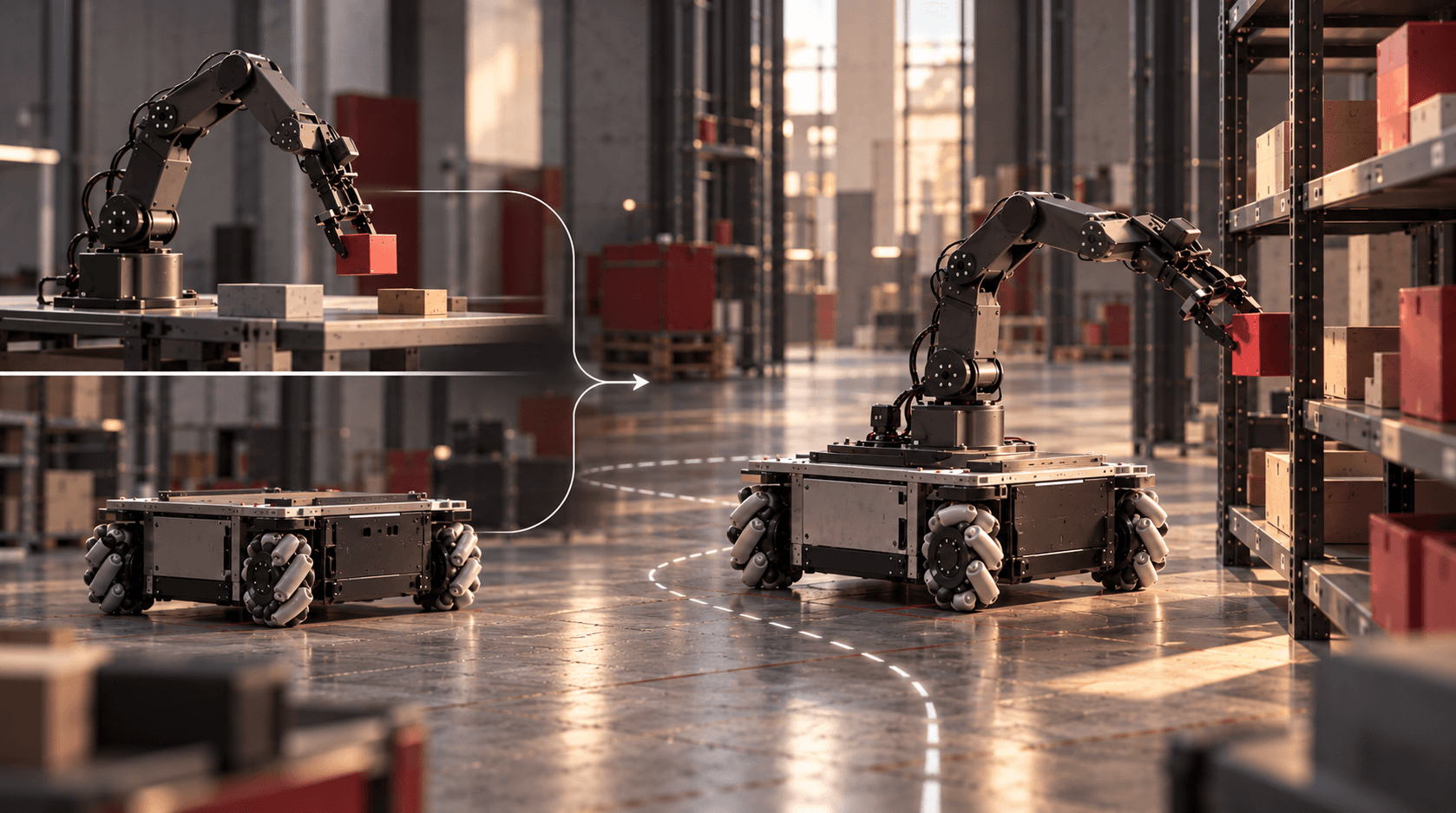
Fixed-base robotic arms deliver high precision, speed, and repeatability across industrial automation tasks. However, their physical utility remains strictly bounded by their reach envelope. Combining a dexterous manipulator with an autonomous mobile platform overcomes this workspace constraint, creating a mobile manipulator capable of traveling across facility floors to execute physical tasks directly at work sites.
1. Expanding Reach Beyond the Fixed Workstation
A conventional stationary robotic arm operates within a fixed sphere defined by its link lengths and mounting base. In warehouse logistics or factory assembly, this setup requires every part, container, or product to be delivered directly to the robot via conveyor systems or feed tables.
Mounting the manipulator onto a mobile base shifts this operational dynamic. Rather than moving materials to the machine, the entire system navigates autonomously between aisles, workstations, and storage racks. The mobile base provides long-distance locomotion, while the multi-joint arm handles local dexterity, grasping, and precise object placement.
2. Mechanical Integration and Kinematic Roles
A functional mobile manipulator delegates operational roles between its two primary sub-assemblies:
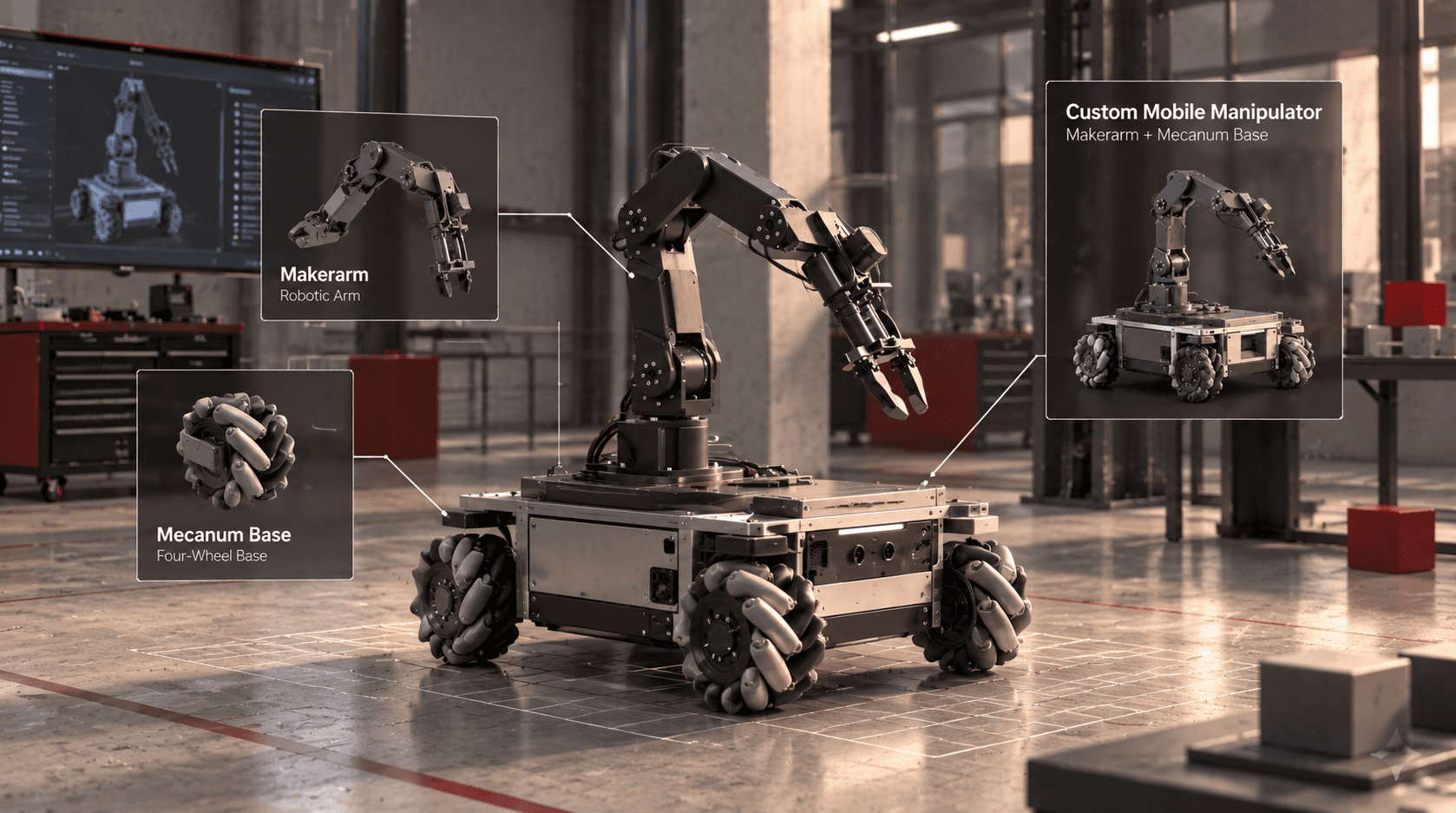
- The Mobile Base: Handles broad-area spatial positioning and ground transportation. Utilizing platforms like omnidirectional mecanum bases allows sideways translation and rotation in tight quarters, positioning the robot accurately in front of shelves or conveyers.
- The Manipulator Arm: Provides multi-axis articulation for reaching, orientation, and contact control. Once the base reaches a target location, the arm executes task-specific trajectories, such as shelf retrieval or bin picking.
To function as a coherent single system rather than two disconnected components, the simulation model must accurately integrate structural mass, contact friction, joint limits, and kinematic joint trees.
3. Coordinated Control: The Unified Challenge
The core technical challenge in mobile manipulation is managing simultaneous navigation and manipulation. Operating a stationary arm involves fixed-base inverse kinematics, but operating an arm on a moveable platform introduces base compliance, shifting centers of gravity, and dynamic coupling.
Modern control architectures address this by implementing whole-body trajectory planners. These controllers calculate wheel velocity inputs and arm joint torques concurrently, allowing the mobile base to adjust its stance dynamically while the arm approaches a moving target.
Testing Mobile Manipulation in Simulation
Prototyping mobile manipulators in physics simulators like MuJoCo enables engineering teams to validate base geometry, test wheel actuators, and calibrate control logic before committing to physical hardware builds. Reusing existing manipulator models such as mounting a Makerarm onto a custom four-wheel mecanum base provides a rapid framework for testing coordinated picking algorithms safely in software.
FAQ
What is a mobile manipulator?
A mobile manipulator is a robotic system consisting of an articulated robot arm mounted on a mobile robot platform. The base provides mobility around an environment, while the arm performs tasks such as grasping, inspecting, or placing objects.
Why use a mecanum base for a mobile manipulator?
Mecanum wheels allow a four-wheeled robot to move in any direction including laterally without turning its chassis first. This omnidirectional mobility helps the system align precisely in narrow warehouse aisles or tight work cells.
How do controllers handle base movement while the arm is active?
Advanced whole-body controllers compute target joint velocities for both the wheels and the arm joints simultaneously. This accounts for shifting payload weight, momentum changes, and base drift during active arm motion.
Why simulate a mobile manipulator in MuJoCo before physical testing?
Physics simulation in MuJoCo allows developers to verify joint contact parameters, test wheel actuators, evaluate collision geometry, and refine navigation algorithms without risking physical hardware collisions.