
Research
How DHL Uses Robots Across Its Warehouses?
DHL runs 7,500+ robots across its network. Here's how mobile robots, picking arms, and Boston Dynamics Stretch handle moving, sorting, and unloading parcels.
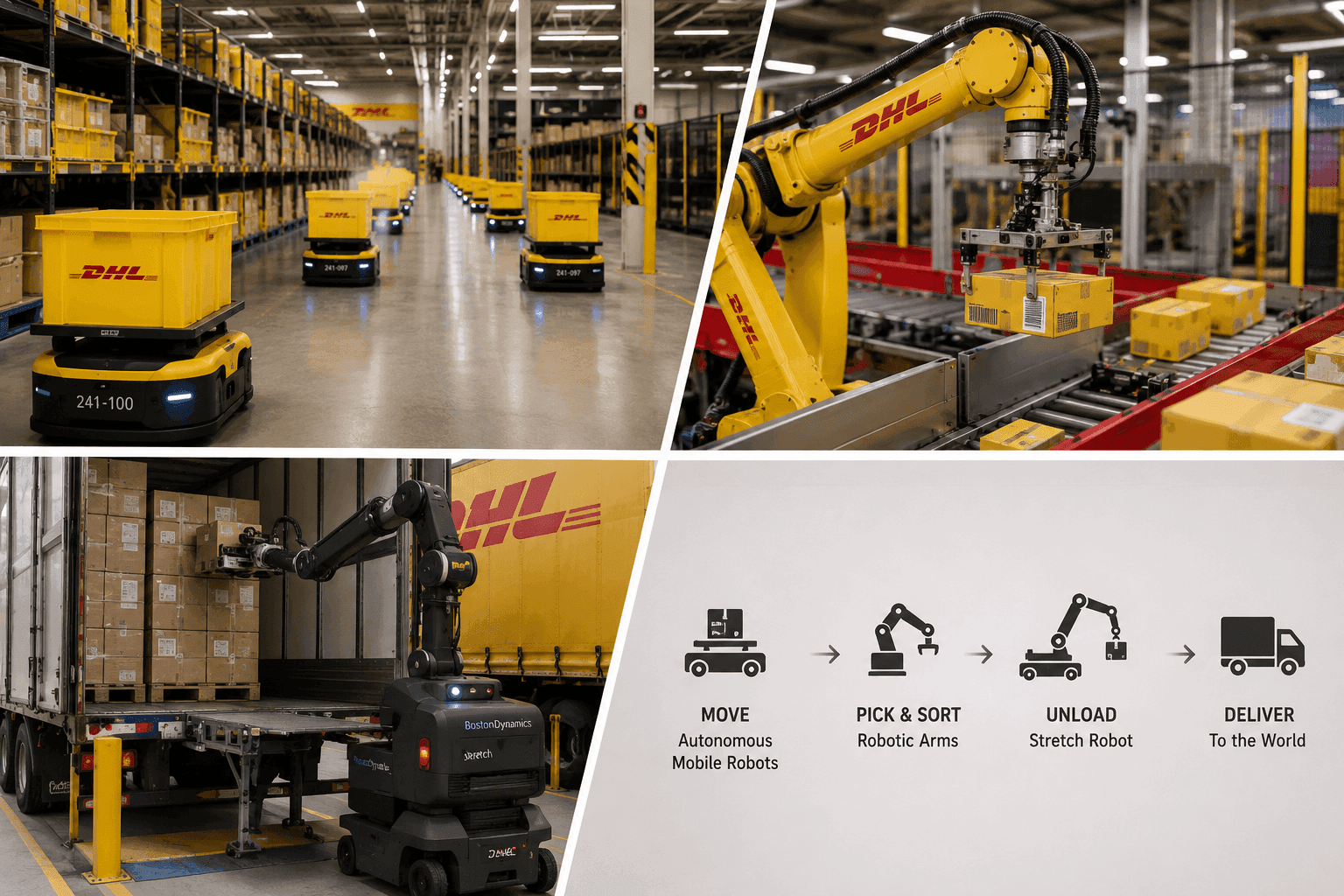
Moving a parcel from a warehouse to your door sounds like a solved problem. Inside a DHL facility, it's a coordination problem being handed, stage by stage, to different classes of robot.
<video>
When you order something online, getting it from a warehouse to your door sounds simple. Inside a DHL facility, understanding how DHL uses robots means following a parcel through several handoffs, each to a robot class built for that specific job: mobile robots move it, arms pick and sort it, and a heavy-duty manipulator unloads it from the trailer in the first place. Here's how those stages fit together at scale.
1. Autonomous mobile robots that move the goods
It usually starts with autonomous mobile robots (AMRs). Instead of workers walking miles across a facility to fetch items, the robots navigate between shelves and bring products to the people picking orders, a goods-to-person model rather than person-to-goods.
DHL runs these at serious scale. It has logged more than 500 million picks with Locus Robotics' LocusBots across its network, a milestone it reached in 2024, with the AMRs deployed across dozens of sites worldwide. The relevant engineering detail is that these are free-navigating AMRs, using onboard sensing to plot paths and avoid obstacles dynamically, rather than following fixed guide markers, which is what lets DHL flex fleet size and even move robots between facilities as demand shifts. It's the goods-movement layer described in how warehouse robots work in general, running in production.
2. Robotic arms for picking and sorting
Once an item is moving, robotic arms take on the repetitive manipulation: picking, placing, and sorting parcels. DHL has deployed AI-powered sorting robots that handle upwards of a thousand small parcels per hour.
This is the hardest part to automate reliably, because it's real pick-and-place manipulation on a mixed stream of items: the arm has to identify each parcel with vision, choose a grasp, and route it correctly, at rate. Throughput numbers like a thousand parcels per hour only hold if the perception and grasping are robust to the variety of a real parcel mix, which is exactly where the difficulty lives.
3. Boston Dynamics Stretch for unloading trailers
One of the toughest jobs happens before a parcel even enters the warehouse: unloading the trailer. It's hot, cramped, physically punishing work, and a hard manipulation problem, densely packed boxes of varying size and weight, no fixed positions, in a confined space.
DHL uses Boston Dynamics' Stretch robot for this. Stretch is a mobile base with a long-reach arm and a smart vacuum gripper that perceives the box wall, plans which case to pull next, and stacks onto a conveyor. Depending on the operation, DHL has reported unloading rates up to around 700 cases per hour. This is the same deformable-and-cluttered manipulation challenge that makes real-world grasping hard, solved well enough for a specific, high-value task.
4. The scale, and what it signals
This isn't a pilot with a handful of demo units. DHL uses more than 7,500 robots across its global network, sourced from multiple partners including Locus Robotics, Geek+, and AutoStore, and in 2025 it signed a memorandum of understanding with Boston Dynamics for the deployment of more than 1,000 additional Stretch robots.
Numbers at that scale change what matters. The hard problem stops being any single robot and becomes fleet orchestration, sequencing thousands of machines from different vendors, routing work between them, and keeping throughput up through demand peaks. That coordination layer is the real system, and it's where a lot of the engineering effort in modern logistics automation actually goes.
How the work gets divided?
DHL's warehouses still run with people in the loop. The model is a division of labor: people, mobile robots, and manipulators each take the portion of the work they're best suited to, with robots absorbing the walking, lifting, and repetitive sorting while people handle exceptions, judgment, and the cases automation can't yet manage reliably.
The net result is that a parcel can move through an entire warehouse with robots involved at nearly every stage, from trailer to shelf to pick to sort. Almost all of the perception, grasping, and navigation behind that is developed and validated in simulation before it runs on a warehouse floor, which is what makes deploying at this scale feasible at all.
FAQ
- How many robots does DHL use? DHL uses more than 7,500 robots across its global network, sourced from partners including Locus Robotics, Geek+, and AutoStore. In 2025 it also signed an MOU with Boston Dynamics for over 1,000 additional Stretch robots, alongside more than 200,000 smart handheld devices and hundreds of thousands of IoT sensors.
- What robots does DHL use for order picking? DHL primarily uses Locus Robotics' autonomous mobile robots (LocusBots) in a goods-to-person model, bringing items to human pickers. It has logged more than 500 million picks with these AMRs across its network, a milestone reached in 2024.
- What does DHL use the Boston Dynamics Stretch robot for? DHL uses Stretch to unload trailers and containers, an unstructured, physically demanding task. Stretch is a mobile robot with a long-reach arm and a vacuum gripper that identifies and pulls cases from a densely packed trailer wall, with DHL reporting rates up to around 700 cases per hour depending on the operation.
- Are DHL's warehouses fully automated? No. DHL uses a mixed human-and-robot model where robots handle repetitive movement, lifting, and sorting while people manage exceptions and judgment-heavy tasks. More than 90% of DHL warehouses have at least one automation or digitalization solution, but they still operate with people in the loop.
- How is warehouse robotics like DHL's developed and tested? The perception, grasping, and navigation are developed and validated largely in simulation before deployment, where behaviors can be tested at scale without disrupting live operations. Tools like Drift generate the simulated robots and environments used for that kind of development work.


