Research
The Robot Brain Is Moving From Code to Models
For decades, we told robots exactly what to do. Now, we're starting to teach them how to figure it out.

Traditional robotics has relied heavily on explicit rules. If an object is detected at a certain position, move the arm there. If an obstacle appears, stop. If a button is pressed, start the next action. These systems can be reliable, but they also depend on engineers anticipating the situations a robot might encounter.
That becomes difficult outside controlled environments. A different object position, an unexpected obstacle, or a small change in the surroundings can require new logic. The more situations a robot needs to handle, the more complicated that rule-based system becomes.
Robotics is now moving toward models that can learn some of these behaviors instead.
From Rules to Learned Policies
A learned policy doesn't need every possible response to be written as a rule. Instead, it learns a relationship between what the robot observes and the action it should take. The training can come from demonstrations, simulation, reinforcement learning, or a combination of these methods.
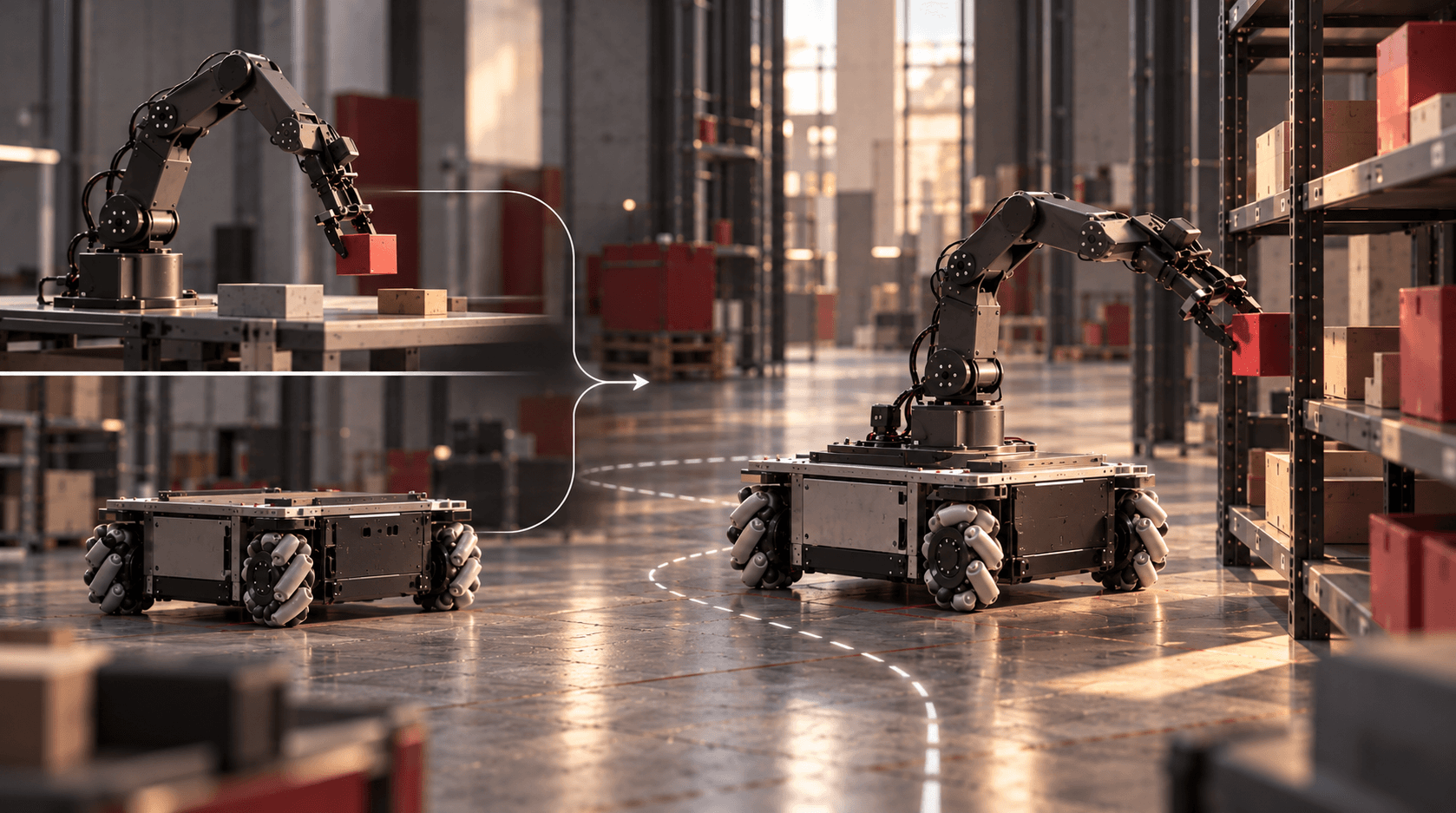
Consider a simple pick-and-place task. A traditional system might rely on predefined positions and trajectories for where the object is expected to be. A learned policy can instead use the robot's observations to determine how it should approach the object and adjust its movement.
The difference becomes more useful when the environment changes. A good policy should be able to handle variations it wasn't shown exactly during training, rather than failing as soon as something moves a few centimetres.
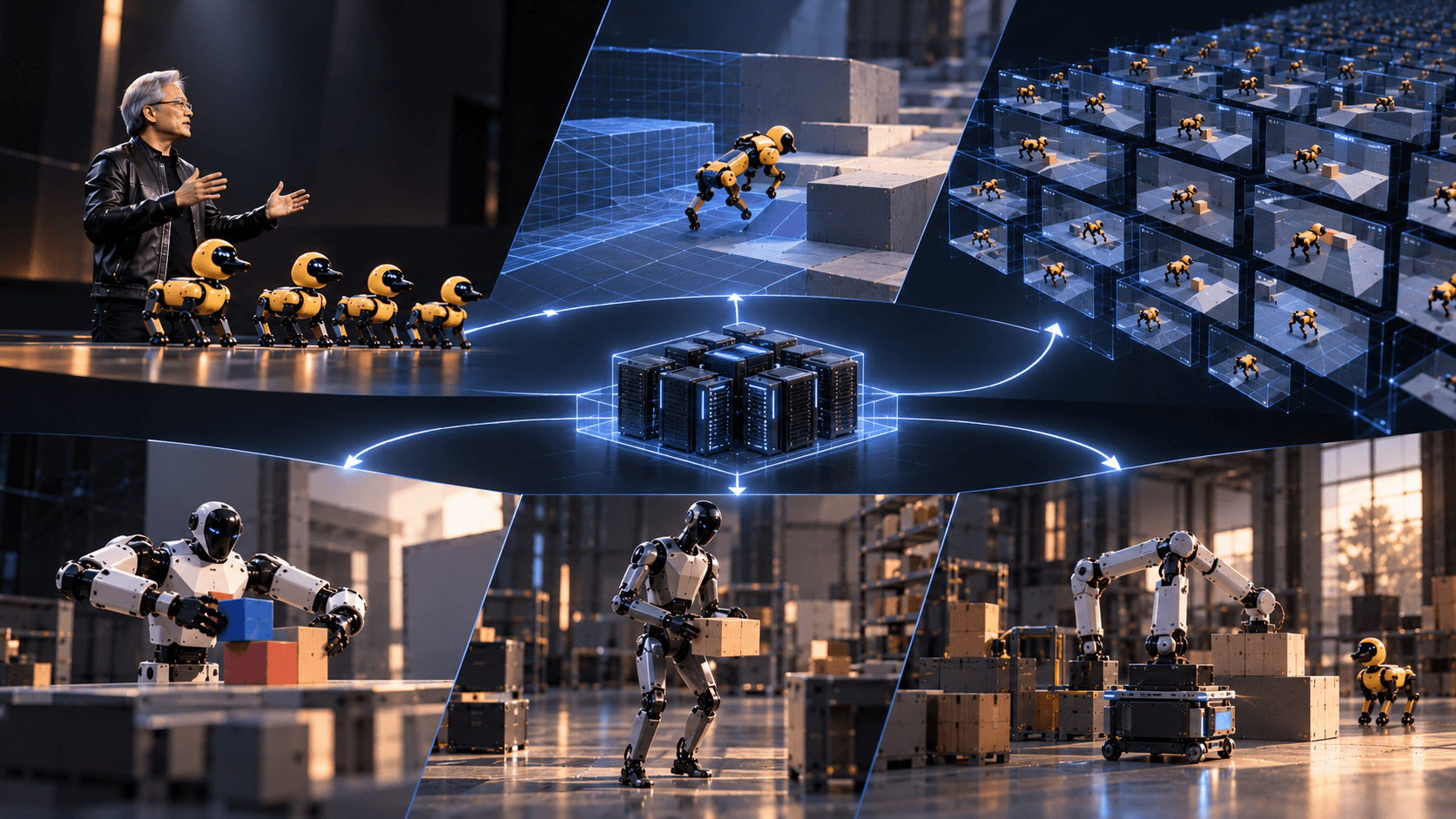
This is one reason simulation has become such an important part of robot learning. In Why Robots Train in Simulation Before the Real World?, we looked at how simulated environments let robots experience different tasks and conditions before those behaviors are tested on physical hardware.
Foundation Models Change the Workflow
The next step is to make these learned systems broader. Robot foundation models are trained on large and diverse datasets so that one model can support multiple tasks, environments, and types of interaction instead of being built around a single behavior.
That changes the way a new task can be introduced. Rather than writing another set of rules and training a separate policy, the same underlying model can potentially use its existing knowledge to handle a new situation.
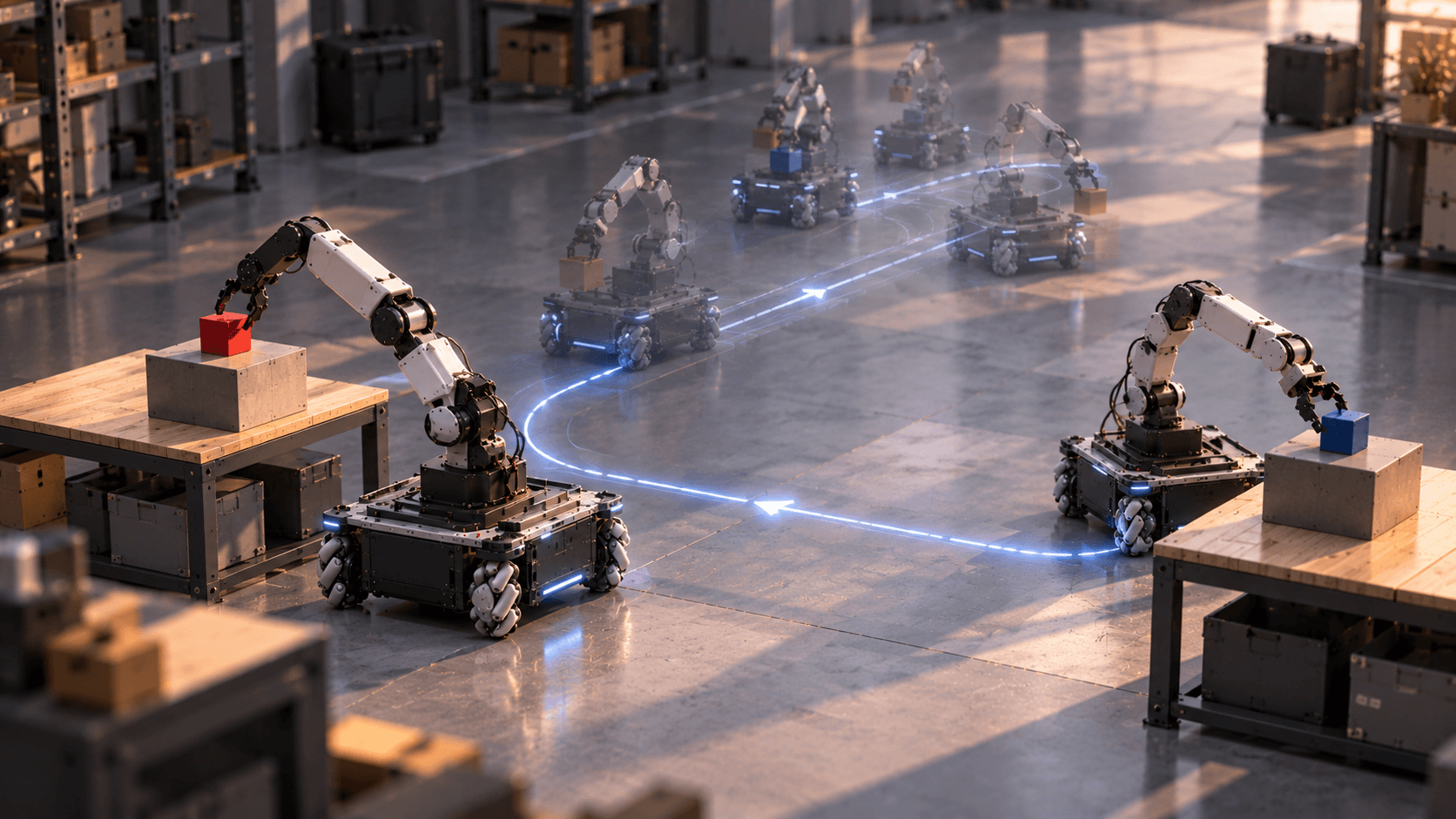
We're already seeing this idea in approaches such as robots learning from a single video demonstration. Instead of creating a new task-specific training pipeline, the demonstration itself provides information about what the robot needs to do.
The model still needs substantial training behind the scenes. The difference is that not every new behavior has to be encoded into the system beforehand.
World Models Add Prediction
Foundation models can help a robot decide what to do. World models take the idea a step further by trying to predict what might happen if the robot takes a particular action.
Imagine a robot reaching for a cup. Before moving, it could consider how different approaches might affect the cup, where the gripper could end up after contact, or what the scene might look like after the action. Instead of reacting only to the current state, the system can use predicted future states when choosing what to do next.
The basic loop becomes observe, predict, act, and observe again.
There is an obvious connection to simulation. In MuJoCo, a robot can take an action in a virtual environment and see the resulting state. A learned world model tries to capture some of that predictive ability within the model itself.
Getting those predictions right is difficult. Physical environments contain friction, sensor noise, unexpected contact, and objects that don't always behave exactly as expected. A useful world model therefore needs to predict the parts of the environment that actually matter for the robot's decision.
What This Means for Robotics
This shift doesn't mean traditional robot software is going away. Controllers still need to convert commands into precise motor movements. Planners still need to handle constraints and collisions. Sensors, hardware interfaces, and safety systems still have to work reliably.
What is changing is where more of the decision-making happens.
A traditional system might explicitly define how the robot should respond to a known situation. A learned system can infer a response from what it has seen during training. A system with a world model could potentially consider several possible outcomes before deciding which action to take.
The progression looks something like this:
Rules → Learned Policies → Foundation Models → World Models
We're still early in that progression, and none of these approaches removes the need for careful engineering. But the direction is clear. Instead of writing instructions for every situation a robot might encounter, we're building models that can learn patterns, generalize across tasks, and eventually reason about what might happen next.
The robot still runs on code.
Increasingly, though, more of what makes it intelligent is inside the model.
FAQ
What is a learned policy in robotics?
A learned policy is a model that determines what action a robot should take based on patterns learned from training data rather than relying entirely on manually written rules.
What are robot foundation models?
Robot foundation models are broadly trained models designed to work across multiple tasks, environments, or robot embodiments rather than being limited to one specific behavior.
What is a world model?
A world model attempts to represent aspects of an environment and predict how that environment could change when the robot takes an action.
Will traditional robot programming disappear?
No. Controllers, planners, sensors, hardware interfaces, and safety systems remain essential. Learned models are increasingly becoming another layer within the robotics stack.