Research
The 5 Most Impressive Robot Dogs Right Now
Robot dogs now inspect factories, patrol borders, and map mines. Here are 5 of the most impressive robot dogs, from Boston Dynamics Spot to the Unitree Go2.
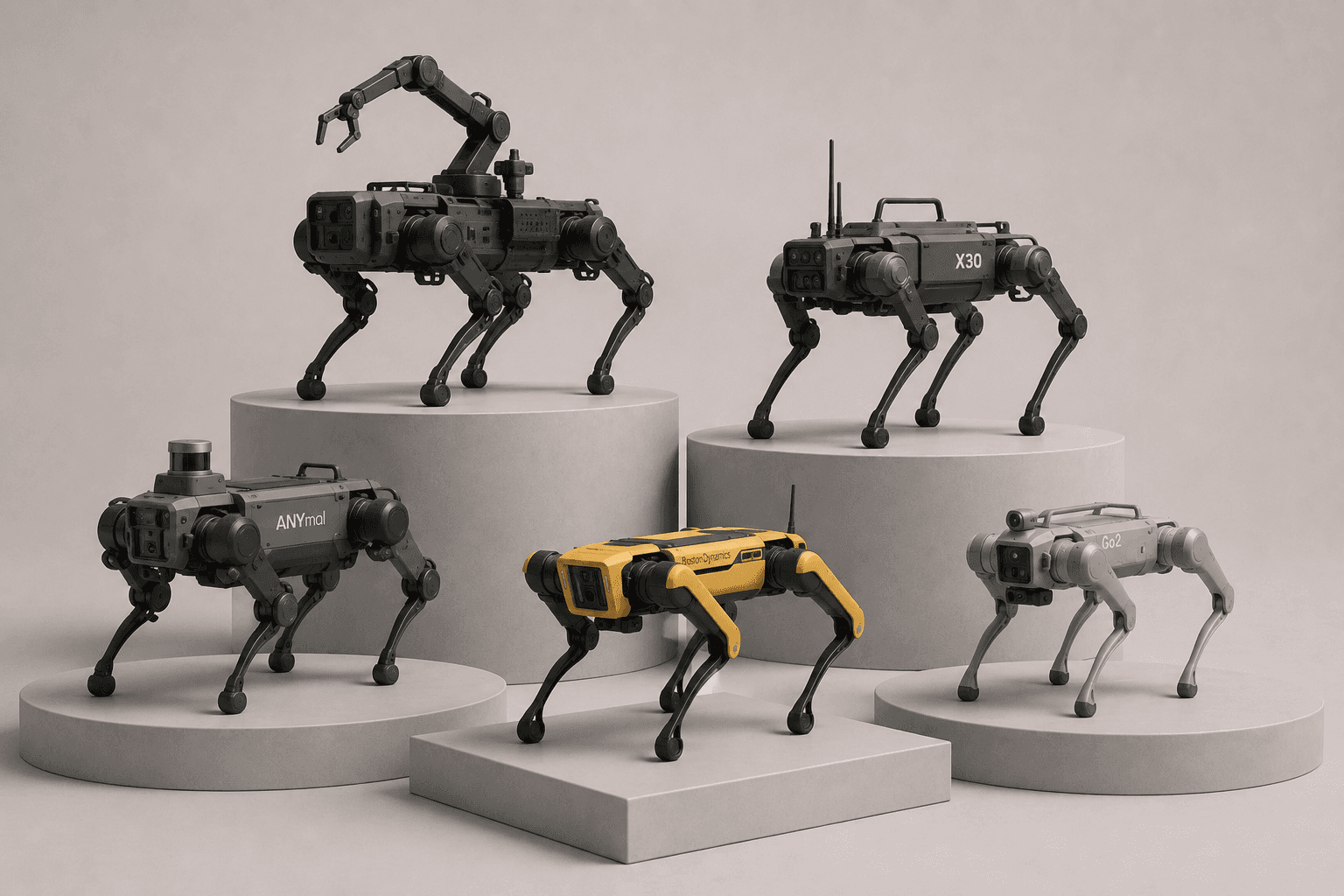
Robot dogs have gone from research demos to real jobs. Some inspect factories, some cross dangerous terrain, and some are learning to work alongside people.
The legged-robot market topped $1.8 billion in 2025 and is projected to keep climbing, which is why these machines are showing up everywhere from power plants to construction sites. Here are five of the most impressive robot dogs you should know, counting down to the most popular of all.
1. Ghost Robotics Vision 60
Let's start with the Vision 60 from Ghost Robotics. This one was built with defense and security in mind, which sets it apart from most quadrupeds.
It's designed to patrol rough terrain, carry specialized equipment, and operate where it may be too dangerous to send a person. It's exceptionally rugged, can be submerged in water, and has even gained an optional arm for manipulation. Its whole purpose is to keep people out of harm's way by going where they can't safely follow.
2. Deep Robotics X30
Where the Vision 60 focuses on security, the X30 from Deep Robotics is built for industry. It's a heavy, ruggedized quadruped, IP67-rated against dust and water, that inspects factories, power plants, and industrial sites.
It climbs stairs, clears obstacles, and navigates complex environments while collecting inspection data, and it's already deployed in jobs like high-voltage station inspection and underground cable tunnels. The pitch is simple: rather than sending workers into hazardous areas, a company can send a robot first.
3. ANYbotics ANYmal
Taking things further is ANYmal, developed out of ETH Zurich and commercialized by ANYbotics. This robot is known for its mobility in genuinely hard places.
It can navigate mines, tunnels, and offshore facilities, creating detailed 3D maps of locations that are difficult or dangerous for humans to reach. It's also been engineered for hazardous industrial settings, including an explosion-proof version certified for use around flammable gases, which is why energy companies have been early adopters.
4. Boston Dynamics Spot
Then there's Spot, the robot dog that introduced millions of people to modern robotics. Beyond the viral dance videos, Spot does serious work: construction, inspection, emergency response, and digital mapping.
With well over a thousand units deployed across dozens of countries, Spot is one of the most widely used quadrupeds in the world, and its mature software and sensor ecosystem have made it the benchmark others are measured against.
5. Unitree Go2
Finally, the Unitree Go2. What makes it remarkable is access: it brings capable quadruped hardware, with AI features like obstacle avoidance and autonomous following, down to a price hobbyists and universities can actually afford.
A built-in lidar and camera give it a 360-degree view, and an open SDK with ROS 2 support makes it a favourite for developers, researchers, and robotics enthusiasts. More than any other robot here, the Go2 is why so many people are now building with quadrupeds, and it's the same platform we've used to explore building a quadruped simulation in MuJoCo.
What these robot dogs have in common?
Each of these robot dogs was built for a different job, from border patrol to factory floors to a developer's workbench. Together, they show how quickly quadruped robots are becoming practical tools across research, industry, and beyond.
They also share the same core challenge under the hood: staying balanced and moving reliably over unpredictable terrain, which is exactly why getting a robot to walk is so hard in the first place. If you want to experiment with the ideas behind these machines, the best place to start is simulation.
FAQ
- What is the most popular robot dog? The Unitree Go2 is among the most popular by units in the field, thanks to its low price, capable AI features, and open SDK. Boston Dynamics Spot is the most widely deployed in enterprise settings, with well over a thousand commercial units across dozens of countries.
- What are robot dogs used for? Common uses include industrial inspection of factories and power plants, security and defense patrols, mapping mines and tunnels, construction site monitoring, and emergency response. They excel at reaching stairs, rubble, and hazardous areas that are unsafe for people.
- How much does a robot dog cost? It ranges enormously. Consumer and research models like the Unitree Go2 start in the low thousands of dollars, industrial platforms like the Deep Robotics X30 run into the tens of thousands, and premium or defense systems like Spot and the Vision 60 can reach well into six figures.
- Which robot dog is best for developers? The Unitree Go2 is a top choice for developers and researchers because of its affordable price, onboard sensors, and open SDK with ROS 2 support. It's widely used for education, research, and prototyping robotics applications.
- Why are quadruped robots useful compared to wheeled robots? Legs let quadrupeds handle stairs, ladders, rubble, and uneven or confined terrain that wheels can't, which is why they're valued for inspection and response in places built for humans rather than machines.
- Can you experiment with these robot dogs in simulation? Yes. Platforms like the Unitree Go2 have widely available simulation models, so you can prototype behaviors virtually before touching hardware. Tools like Drift generate quadruped simulations in MuJoCo from a natural-language prompt, which is a low-cost way to explore the locomotion and navigation ideas behind these commercial robots.