
Product
Watch a Quadruped Take Its First Steps in MuJoCo
You have a quadruped standing in simulation. Now it needs to walk. See how Drift generates a quadruped walking controller in MuJoCo from a single prompt.
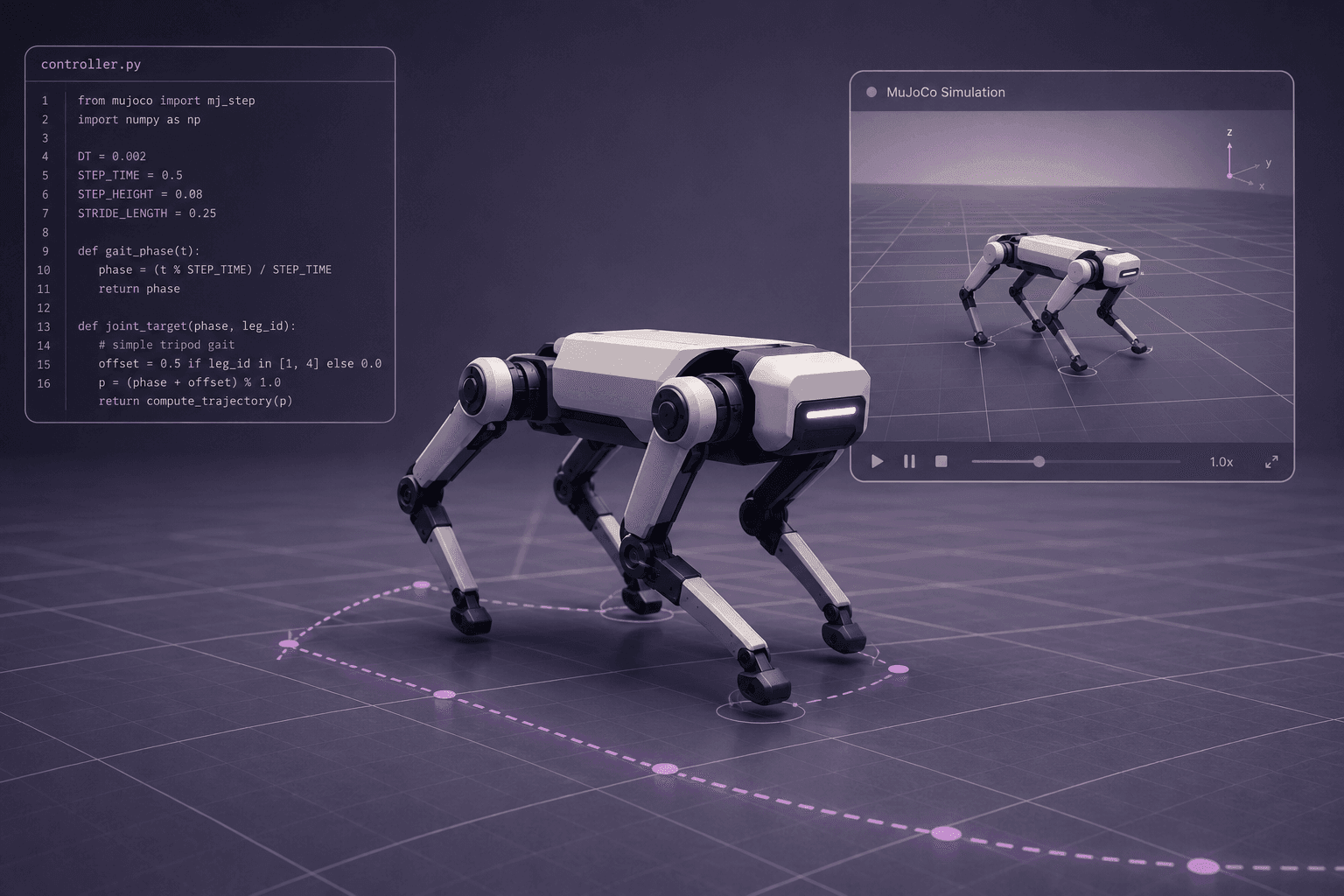
We already have a quadruped standing in simulation. Standing still isn't much fun. The next step is getting it to walk.
In the last build we created a quadruped simulation in MuJoCo. A four-legged robot standing in an empty scene is a good start, but it isn't doing anything yet. This walkthrough adds a quadruped walking controller, and rather than writing the gait logic from scratch, we ask Drift to generate it from a single prompt.
Why getting a quadruped to walk is hard
Getting a legged robot to walk is one of the classic hard problems in robotics. A gait has to coordinate many joints in the right sequence, keep the robot balanced, and stay stable as it moves. Writing that controller by hand takes real effort before you see a single step.
That's the gap this closes. We use the existing quadruped simulation and let Drift produce a basic walking controller, then we run it and see how it performs.
Generating a quadruped walking controller with Drift
Starting from the quadruped scene, we give Drift a simple prompt: generate a basic walking controller for the robot. From there it produces the gait logic and wires it into the simulation, ready to launch. If you're just getting started with the simulator, here's how to install MuJoCo and build the quadruped scene first.
Watching the quadruped take its first steps
With everything generated, we launch the simulation. And there it is: the quadruped taking its first steps.
Seeing the robot actually move is the payoff, but it's also just the beginning. A working first gait is the foundation you build on, not the finish line.
Inspecting the generated walking controller code
Getting the robot to walk is one thing. Understanding how it walks is another, and that's where the generated code matters.
Drift also produces the controller code, so you can open it in your editor and see exactly how the walking sequence is implemented. Instead of a black box that happens to work, you get readable logic you can follow, learn from, and modify.
Tuning gait parameters like step timing and joint motion
Once you can see the code, you can experiment. Dive in and adjust parameters like step timing or the range of joint motion, then rerun the simulation and watch how the walk changes.
This is one of the best ways to build intuition for legged locomotion. Small changes in timing or stride can noticeably change how the robot moves, and being able to tweak and re-test quickly is how you develop a feel for what each value does.
Where to go after your first quadruped gait
Getting a quadruped walking is the start. The real value is understanding how the controller works and building on it. From a first gait you can refine stability, try different walking styles, or move toward training reinforcement learning policies for more robust locomotion.
With Drift generating the initial framework and the code behind it, you're free to explore, experiment, and keep improving from there. Load your quadruped, generate a gait, and start tuning. The full walkthrough is in the video above.
FAQ
- How do you make a quadruped walk in simulation? You need a walking controller that coordinates the robot's joints into a stable gait. In this walkthrough, Drift generates a basic walking controller for an existing quadruped simulation from a single prompt, then launches MuJoCo so you can watch it walk.
- What is a walking controller or gait controller? It's the logic that tells a legged robot how to move its joints over time to produce a walk. A good controller sequences the legs, keeps the robot balanced, and maintains stability as it moves forward.
- What parameters affect a quadruped's walking behavior? Common ones include step timing, stride length, and the range of joint motion. Adjusting these changes the rhythm and style of the gait, and experimenting with them is a good way to understand how each value influences the robot's movement.
- Can you train a quadruped to walk with reinforcement learning? Yes. Beyond a hand-designed gait, reinforcement learning is widely used to train more robust quadruped locomotion in simulators like MuJoCo, often using Gymnasium's quadruped environments, and many of those learned policies transfer to real hardware.
- What does Drift generate for a walking quadruped? Drift generates the walking controller and the underlying code, and launches the simulation. Because you get readable controller code alongside a working demo, you can inspect how the gait is implemented and tune it yourself.


